
Successful modifications implemented in 2025
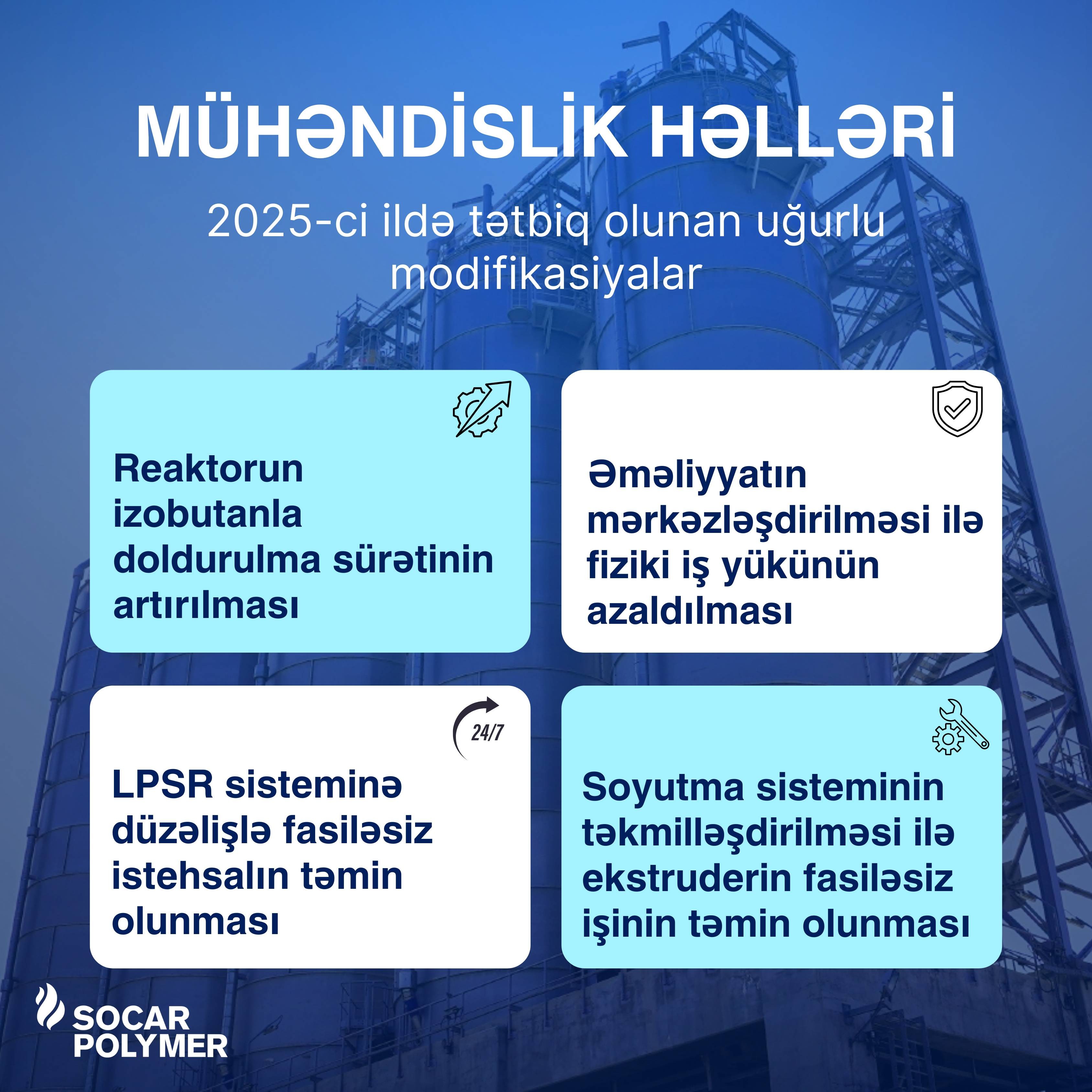
The following modifications were successfully implemented at the SOCAR Polymer plant in 2025:
- As a result of the installation of an auxiliary line to the isobutane dryer in the HDPE polymerization unit, the isobutane filling rate was increased from 1.5 tons per hour to 3 tons per hour. At the same time, after maintenance and repair works, the overall reactor filling time was reduced by 50% while maintaining the quality of raw material, thereby optimizing the reactor’s return-to-production time.
- Before maintenance operations in the co-catalyst area of the HDPE polymerization unit, flexible hoses (with multiple connections opened and closed each time) were replaced with permanent metal pipes on a single manifold to ensure the safe flushing of pyrophoric (TEAL) liquid with mineral oil. Before the modification, the “process liquid cleaning” operations were carried out at five separate technical connection points each time; after the modification, they were centralized at one coordination point via the manifold. As a result, air-to-oxygen contact with the process was prevented, technical safety levels were increased, the number and volume of physical operations were reduced, and the execution time of the works was optimized.
- A replacement line was installed in the HDPE polymerization unit within the LPSR (low pressure solvent recovery system) for the blowing unit, operating on the "bypass" principle. The commissioning of this line allowed the process to continue without interruption during equipment failure or maintenance, ensuring production continuity and increasing overall system reliability.
- In the extruder unit, which plays a crucial role in the production of HDPE pellets, the plate heat exchanger of the polymer cutting block was upgraded based on engineering reports. By optimizing the number of plates, the cooling water flow rate was increased, and the occurrence of scaling and other contamination in the heat exchanger was significantly reduced. As a result, the intervals between preventive maintenance were doubled, and the continuous stable operation of the extruder unit was ensured.